
The Voice returns home
This symbolic drum, confiscated in 1916 in Adjamé, a district of Abidjan, by the French colonial authorities, is about to make its great return to Côte d’Ivoire.
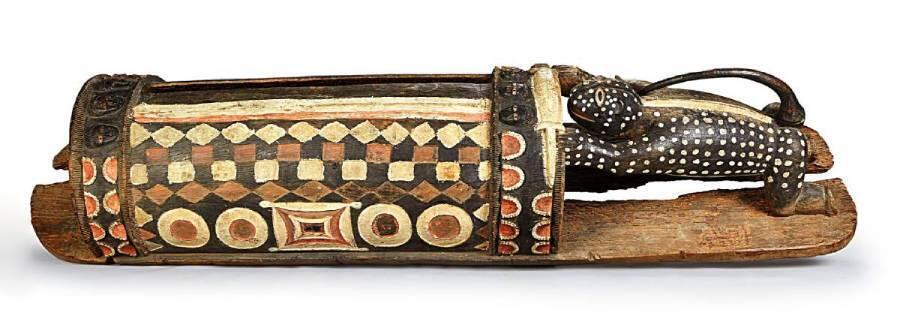
It is one of the most iconic objects in the collections of the Musée du Quai Branly–Jacques Chirac. The monumental talking drum of the Atchan community in Côte d’Ivoire is preparing to leave Paris for Abidjan. Added to the French national collections in 1930 after being “seized” by the colonial administration in 1916, it has now become one of the defining symbols of an unprecedented process: the restitution to Africa of major cultural treasures that have long been preserved in Europe.
Carved from a massive tree trunk and hollowed with extraordinary acoustic precision, the talking drum was far more than a musical instrument. Among the Atchan and Baoulé peoples, as well as many other societies across West Africa, it served as a means of long-distance communication. Its language was based on reproducing the tonal patterns of local languages, enabling it to announce ceremonies, warn of danger, or summon entire communities. A true “bush telegraph”, it connected villages and structured communal life. Collected during the interwar period, the drum preserved in Paris was first exhibited at the Musée de l’Homme before being transferred in 2006 to the galleries of the Musée du Quai Branly. Standing nearly two metres tall, it is striking both for its visual presence and its sonic power. Even in silence, it carries within it the memory of countless voices.
Worn by the passage of time, the drum underwent an ambitious and painstaking restoration beginning in 2015. The work involved reinforcing the wood, treating it against parasites, and stabilising its cracks. This delicate “surgery”, carried out in collaboration with Ivorian experts, became an essential prerequisite for its eventual return. As one curator at the Paris museum remarked at the time, “To restore such an object is to restore its dignity.” The restitution of African artworks took on a new dimension in 2017. In his speech in Ouagadougou on 28 November, newly elected French President Emmanuel Macron announced his intention to initiate the return of African heritage held in France. Shortly afterwards, he commissioned French art historian Bénédicte Savoy and Senegalese writer Felwine Sarr to lead a study on a subject that was as politically sensitive as it was museological.
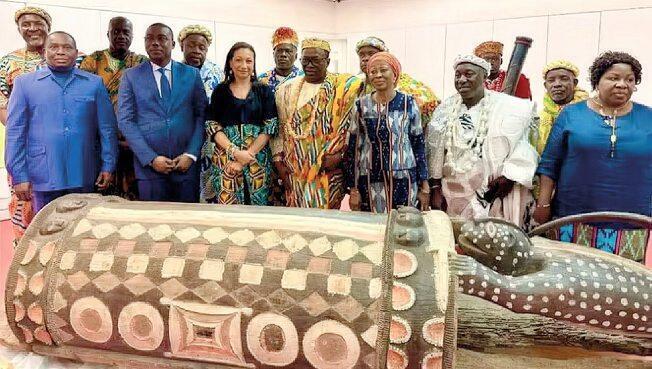
Published in November 2018, their report recommended the conditional restitution of objects removed from the continent during the colonial era without the consent of their communities. Among them was the Ivorian talking drum. In 2019, Côte d’Ivoire formally requested the restitution of the drum, along with 148 other significant cultural objects. The French President reaffirmed this commitment during the Africa–France Summit in Montpellier in October 2021. Following an initial temporary loan agreement signed on 18 November 2024 with the Museum of Civilisations of Côte d’Ivoire, the process gathered pace.
On 28 April 2025, the French Senate passed the bill authorising the restitution. The National Assembly followed on 7 July. The law was promulgated on 16 July 2025 and came into force two days later, on 18 July. From that date, the talking drum officially ceased to be part of France’s public collections. The legislation also established a maximum period of one year for its physical transfer to Côte d’Ivoire, setting the final deadline at 18 July 2026.
In Abidjan, the Museum of Civilisations of Côte d’Ivoire is preparing to welcome the instrument into its newly renovated galleries. The aim is to make it the centrepiece of a permanent exhibition devoted to sound arts and traditional systems of communication. For the Ivorian authorities, its return is about much more than cultural heritage. “This drum is a voice returning to us,” says an official from the Ministry of Culture.
The departure of the talking drum from the Quai Branly reflects a profound shift in the relationship between European museums and Africa: one no longer defined by unilateral possession, but by partnership. When the instrument leaves Paris, it will be less a farewell than a passing of the torch. For the talking drum has never truly fallen silent. In the museum in Paris, it told visitors of the inventiveness of a vanished language. In Abidjan, it will recover its place as a living symbol—a voice restored to those who carried it and understood it.