
Inspiring excellence
Public policies designed to promote integration through work have changed many lives for the better. From training courses and internships to business start-ups, the government aims to support motivated citizens.
Yvonne Doua Bleu, shopkeeper
“Food is my life.”
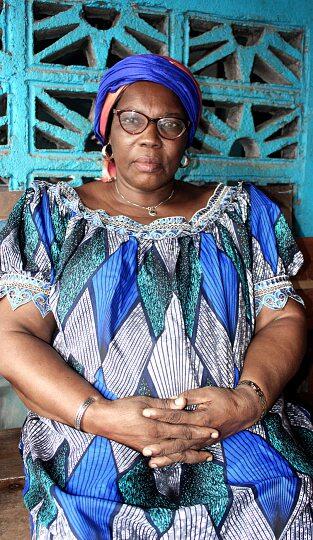
“Thank you to the government of Côte d'Ivoire. Their interest in me is obvious, because the MFFE helped me to find my happiness.” Yvonne Doua Bleu, originally from Man in Côte d'Ivoire's mountainous west, has been working in the food production sector for over twenty years. “The land always inspires me to do something better. Fresh produce is my passion”, she explains. In the 1980s, as a little girl, she already dreamed of working the land and taking up the daba (a traditional West African farming tool, Ed.).
When she was in primary school, she read about cooperatives in one of her textbooks. She latched on to the idea and decided, at the age of 20, to work exclusively in food crops. “I do a bit of everything, but it's cassava that inspires me most,” she says. And that's how her attiéké (acheke) factory, which also supplies gari and starch, came into being. She has warehouses in Abobo, one of Abidjan's largest municipalities, and Azaguié, in the department of Agboville. “Azaguié is where the cassava is processed into paste, and Abobo is where it is processed into attiéké.”
In 2001, as head of the association she set up called COFEDA, the Abobo Women's Cooperative, which brings together thirty women traders working on the Abobo market, she decided to convert the association into a cooperative, “so that the State of Côte d'Ivoire would take it into account”.
In 2018, thanks to the cooperative's success, the Ivorian government took an interest in COFEDA. Belmonde Dogo, then Secretary of State at the Ministry for Women, Family and Children (MFFE), travelled to Brofodoumé, in the south, to congratulate ‘these determined women’ and present them with gifts, including a grinder worth 1.5 million CFA francs. This visit had a positive impact on the structure's yields.
“Before we got this crusher, we used to work by hand or hire one. That meant spending a lot of money... It was hard to get by”, explains Yvonne. In 2019, thanks to the ministry, she was able to take a training course at the FDFP. Today, COFEDA, which has signed an agreement with the MFFE, operates its own attiéké factory, warehouses and shops.
The cooperative has also benefited from the FAFCI and MFFE funds, to the tune of 22 million CFA francs. These are grants to be paid back over ten months, at a rate of 12%, without any prior savings or endorsement. "In a few months' time," says Yvonne, “the next fund will be allocated to us, so that each member of COFEDA can benefit from loans to develop her own business.” For the past four years, Yvonne has been trading mainly in Abobo.
She lives with her husband and their children in Azaguié, where she is also a local councillor. Keen to pass on her passion and legacy, Yvonne Doua Bleu is already inviting her youngest daughter, Amy Claudia Manuel, 22, to follow in her footsteps.
Orédia Zouh, Executive Assistant
“I can now manage a few major expenses.”

Orédia Cabrela Guéladéo Zouh, 23, is an executive assistant. Even though she's young, she's meticulous and efficient. She graduated from the Pierre-Marie Yopougon Maroc Technical High School (ISTG) with a secretarial certificate, followed by a management assistant diploma (BTS) from the Cocody Technical High School, before taking the plunge into the professional world.
She took advantage of the government's Youth Employment Agency (AEJ) programmes, joining one of the schemes offering career advice, training and employment opportunities. By turning to the AEJ, Orédia has been able to achieve greater financial stability. “The aim of the programme I followed was to train me properly, so that the company I work for would consider keeping me on and hiring me permanently!” For the past six months, she has been working in a company specialising in a number of different businesses, from real estate to promotional items, and it's after six months that interns can hope to secure a fixed-term contract. So far, her employers seem satisfied with her. And so, this confident young woman is keeping her fingers crossed.
“I now feel more financially and socially secure, and I can manage a few major expenses”, she says enthusiastically. This is not the case for all young people, however. “It undoubtedly depends on the experience and destiny of each individual. The Youth Employment Agency gives us the opportunity to acquire skills and find work. Then it's up to each individual to make the effort. If a young person behaves badly or doesn't have the required skills despite the training, clearly they won't be taken on”, she concludes.
Narcisse Kouassi, Youth Employment Agency beneficiary
“All in all, I'm satisfied.”

Narcisse Kouassi, 27, has just been taken on at Nouvelles Brasseries de Côte d'Ivoire (NBCI) in Bonoua, 65 kilometres south of Abidjan. “It's all thanks to signing on at the Youth Employment Agency, which helps us find our work placements, and even a job after vocational training. It trains us and gives us state-recognised certificates, which also allow us to go into business. The programmes I followed helped me to understand how soft drinks are made. Now I get paid at the end of every month, so I can look after myself. I'm no longer dependent on my parents. All in all, I'm satisfied.”
Narcisse Kouassi graduated from the Institut Famah d'Abidjan in 2020 with a tecnhnical certificate (BTS) in agri-food industry, majoring in inspection. After a traditional school career, getting his junior high school certificate in 2013 and his A-levels in 2018, Narcisse Kouassi hit a few bumps in the road. He did his first work placement at the Technological Research Station (SRT) of the National Agricultural Research Centre (CNRA) in Bingerville, but without ever receiving any remuneration, and so he decided to leave after three months.
He tried his luck again, and this time it was the right address. Now living in Bonoua, he earns 150,000 CFA francs as a first salary. For him, it's a good start. “It's going to change my life.”
Bonaventure Kouamé, Decorator
“I put my trust in the government.”

He has been working solidly for two days. Features drawn, he tries to keep his eyes open on the journey from Abidjan to Yamoussoukro, for the second time in two days. “We have an event in Yamoussoukro this Tabaski (Eid al-Adha, Ed.) weekend!”
Bonaventure Kouamé lives and breathes events. ‘Événmentiel’ is a buzzword in Côte d'Ivoire, and refers to all events, festive or otherwise, from weddings to funerals. In this professional sphere, you meet hostesses, florists, singers and musicians... But this young man is a decorator. In 2018, having passed his A-levels, he couldn't afford to pursue higher education. So he had to make a living from odd jobs, specialising as he went along in decorating for all kinds of festivities. After struggling for a few years, he joined the Youth Employment Agency: “I put my trust in the government, and applied for a job in project management and event project coordination”, he says, adding that it was because of his reluctance and mistrust that he applied so late.
This is something he regrets, however, as he feels he wasted time. “It was only after hearing a lot of positive feedback from young people like me that I finally believed in it.” Bonaventure, 28 years old and a father of two, is a determined man. “Today, things are looking up for me.” After a six-month training course, followed by a six-month work placement at Côte d'Ivoire Événements, the company has just taken him on. "There were a few of us trainees. They all withdrew because it was unpaid work. I stuck to my guns and made sure I was always on time. And it paid off: I've just signed my first fixed-term contract with the company!”