
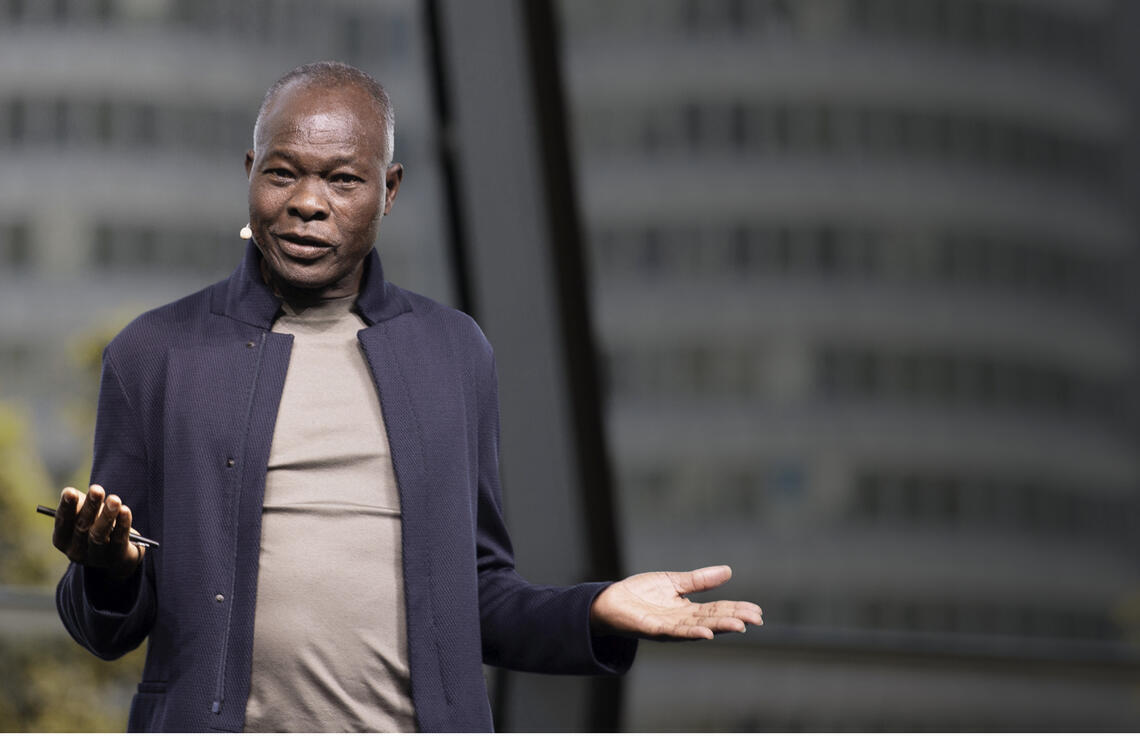
Francis Kéré
Burkina Faso / Germany
Sustainable architecture
Globally acclaimed, he is reinventing contemporary architecture through techniques rooted in traditional building practices, particularly those adapted to a changing climate.
The first African to receive the prestigious Pritzker Prize, architecture’s highest honour, in 2022, Diébédo Francis Kéré was born in 1965 in Gando, Burkina Faso, and began his career as a carpenter. A scholarship to study architecture in Berlin changed his life. In 1998, from Germany, he launched an association to build a school in his native village. From this very first project, Kéré demonstrated his creative genius. He built walls from compressed earth blocks—less expensive and less energy-intensive than concrete—and topped them with a raised roof that provides natural ventilation. Another innovation was his decision to involve the entire village community in the construction of the school. Francis Kéré has a particular fondness for wood, whose “warmth, silence, scent and softness” he appreciates. He designs environmentally responsible buildings not only in Africa, but also in China, the United States and Europe, particularly in Germany, where he is now a citizen. In 2025, he inaugurated eleven schools of his own design in Burkina Faso, “where [his] heart resides.” He has recently completed his first permanent project in Europe, in Munich, on the campus of the Technical University of Munich: a five-storey, entirely wooden childcare centre known as the “Children’s Oasis” (Kinderoase). Designed to “stimulate the imagination,” its originality has attracted considerable attention from the German media. Kéré recalls that, while studying in Germany, he “developed an interest in the stability and durability of materials,” while always keeping “his eyes fixed on Africa.” The continent continues to inspire him through its building methods, particularly its traditional openwork ventilation systems, which are especially well suited to the heatwaves brought on by climate change. By bringing African building techniques to wider attention in Europe, Francis Kéré embodies a form of architectural sovereignty.