
Ethiopia, the dam and
the politics of the Nile
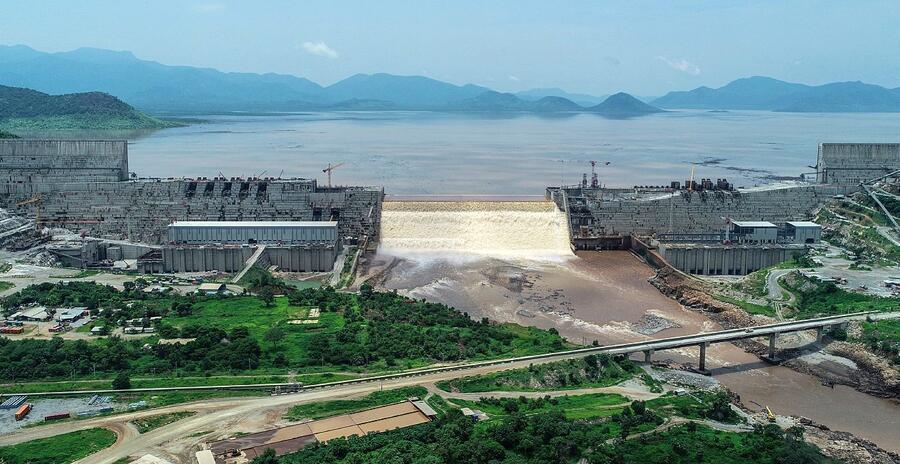
After fifteen years of pharaonic construction, Ethiopia officially inaugurated “its” Grand Ethiopian Renaissance Dam on September 9. Despite the reluctance of international donors and threats from Egypt, the authorities brought this colossal project to completion by mobilising the population. A historic achievement for a nation in search of sovereignty—and grandeur.
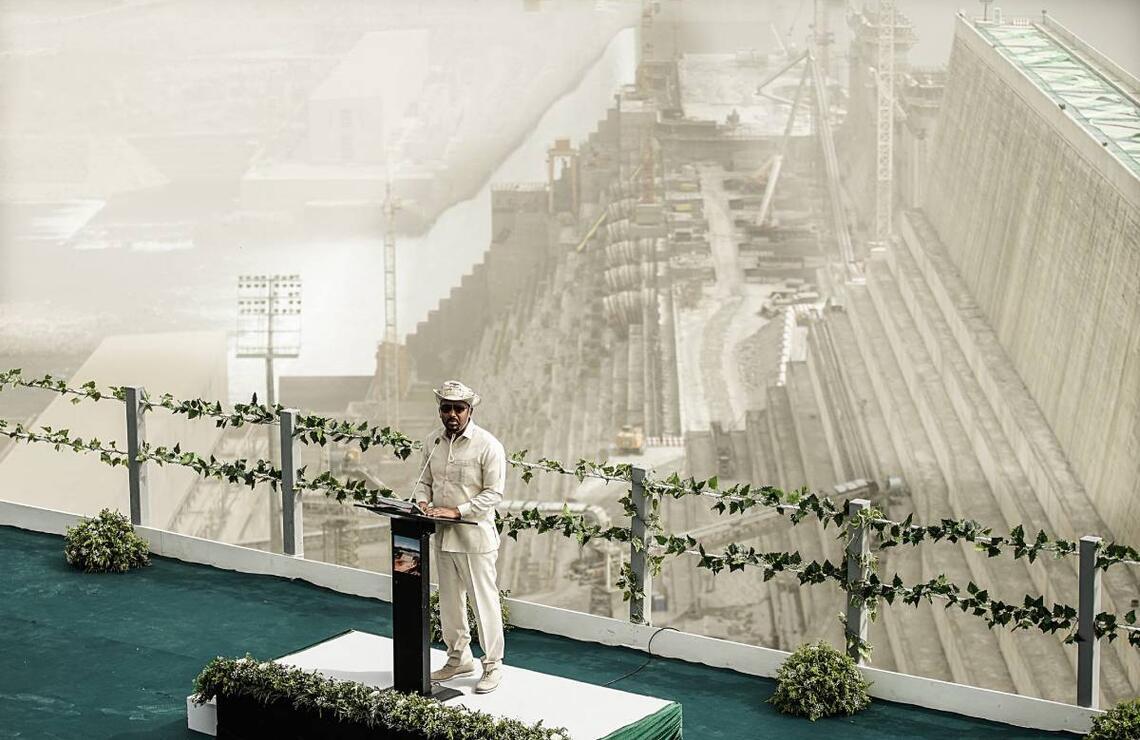
Abiy Ahmed spared no expense in inaugurating the Grand Ethiopian Renaissance Dam (GERD), the largest hydroelectric complex ever built on the African continent. Standing before the colossal structure draped in Ethiopian flags, the Prime Minister delivered an almost messianic speech.
“Previous generations dreamed of harvesting the Abay River,” he declared, using the Ethiopian name for the Blue Nile. “Today, that dream is coming to life.” Aerial displays by Ethiopian Air Force fighter jets gave way to nighttime choreographies of illuminated drones, tracing slogans across the sky in Amharic and English: “Geopolitical Awakening,” “A Leap into the Future,” and “Happy New Year.” The ceremony took place on September 9, two days before Enqutatash, the Ethiopian Orthodox New Year. The inauguration was more symbolic than technical. The reservoir began filling five years ago, the first turbines have been generating electricity since February 2022, and construction was completed last July. Yet Abiy Ahmed is determined to maximise the political value of a megaproject that had been envisioned for nearly a century, launched in 2011 by Prime Minister Meles Zenawi (1955–2012), and ultimately completed under his own leadership.
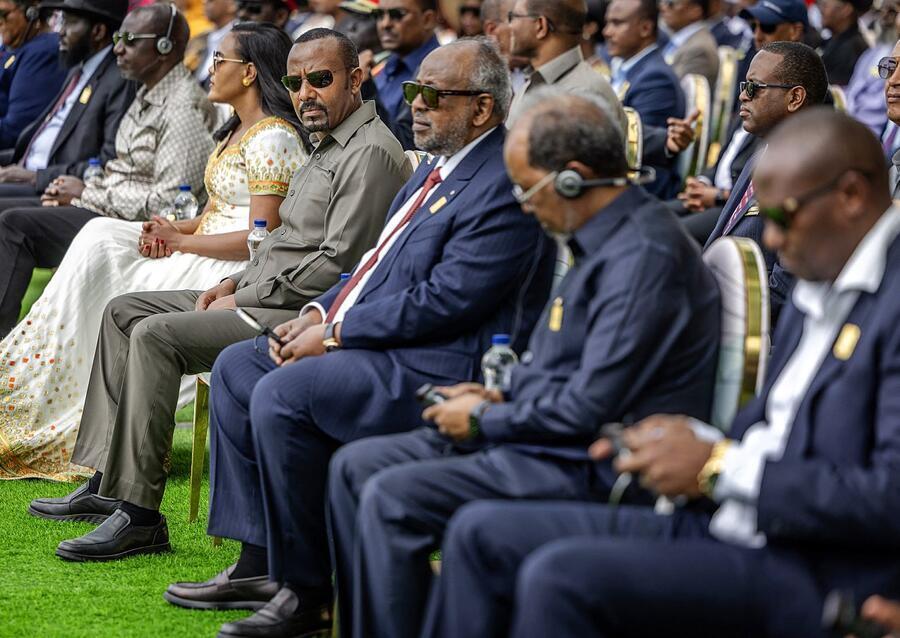
The Ethiopian government needs what Sonia Le Gouriellec, a Horn of Africa specialist and professor at the Catholic University of Lille, describes as “a national totem that provides a unifying narrative.” She explains: “By completing the GERD despite internal conflicts and diplomatic pressure, Ethiopia’s leaders turned it into an emblem of rebirth, going beyond its simple energy function to become a project of nation-building, regional assertion, and a break with the colonial legacy.” A totem towering above the bloody fractures of Ethiopia’s complex national mosaic. Although the war in Tigray has ended—with at least 600,000 people killed between November 2020 and November 2022—the country continues to endure two other internal conflicts: in Oromia, where the Oromo Liberation Army (OLA) remains active, and in the Amhara region, where the nationalist Fano militias have gained strength. During the inauguration, visiting leaders competed in their praise. Kenyan President William Ruto congratulated his “brother,” declaring: “Our future will depend on what we do today and on the vision we carry, on the hopes of our peoples that we turn into reality.” Djiboutian President Ismaïl Omar Guelleh described the dam as “a historic event through which the sister nation of Ethiopia holds the image of Africa very high.” For South Sudan’s President Salva Kiir, the GERD is “a symbol of unity, sacrifice, and determination.” More surprising was the presence of Somali President Hassan Sheikh Mohamud, given the tensions between Somalia and Ethiopia. On 1 January 2024, Addis Ababa signed a memorandum of understanding with Somaliland, whose separatist authorities proposed leasing part of their coastline to landlocked Ethiopia in exchange for diplomatic recognition. For Somalia, the agreement amounted to a casus belli. Mogadishu responded by signing a military cooperation pact with Egypt, and no fewer than 3,000 Egyptian soldiers are now stationed in Somalia, officially to assist in the fight against jihadist groups. In early July, Egyptian President Abdel Fattah el-Sisi, speaking alongside Hassan Sheikh Mohamud at a joint press conference, reaffirmed Egypt’s commitment to “help Somalia control its territory.” Egypt and Sudan had both declined Ethiopia’s invitation. At the GERD inauguration, the Somali president echoed the position of his new ally: “Downstream and upstream nations can prosper only when we act as one community,” he said.
A source of conflict
CK-TravelPhotos / Shutterstock
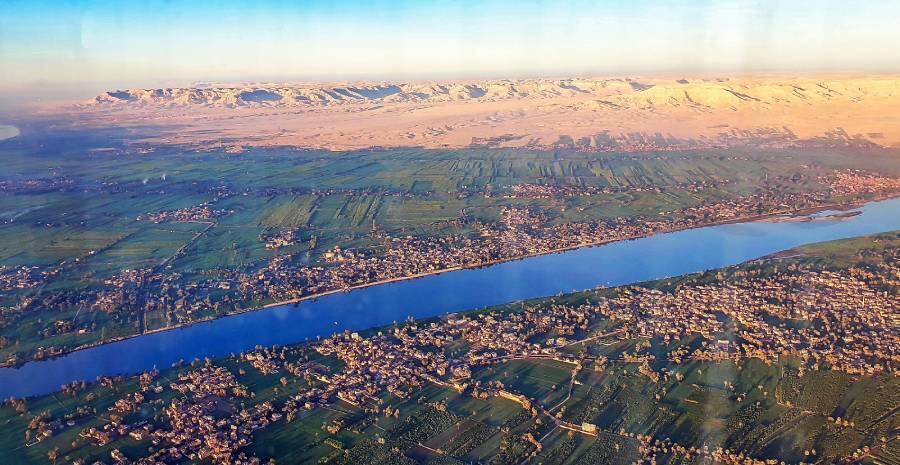
If Ethiopia is celebrating, Egypt is seething. For millennia, the Nile has been inseparable from Egyptian identity. As early as the fifth century BC, the Greek historian Herodotus described the land of the pharaohs—whose agriculture depended on the fertile silt deposited by the river’s annual floods—as “the gift of the Nile.” Today, no fewer than 97% of Egypt’s 116.5 million people rely on the river for their water supply. Yet up to 85% of the water that reaches Egyptian territory comes from the Blue Nile, whose source lies in Ethiopia. A report published in 2017 by the Geological Society of America (GSA) warned that “freshwater problems and energy deficits in the Nile Basin will be seriously exacerbated in the coming years by the construction of the GERD.” Two days before the inauguration, Cairo wrote to the United Nations Security Council, denouncing what it called “a unilateral measure in violation of international law.” Egypt insisted that it was entitled to use “all measures permitted under international law and the United Nations Charter to defend the existential interests of its people.” Protecting the Nile is enshrined in Article 44 of the Egyptian Constitution. Although the management of transboundary rivers is governed by a 1997 UN convention, neither Egypt, Ethiopia, nor Sudan has ever signed it.
Former Ethiopian Prime Minister Meles Zenawi had anticipated Egypt’s categorical opposition to his hydroelectric ambitions. The GERD project, initiated quietly at the end of 2009, remained a closely guarded secret until its official announcement on 31 March 2011—just two days before the laying of the foundation stone. Egyptians reacted with shock and fury, accusing Zenawi of exploiting the power vacuum created by Egypt’s revolution against the regime of Hosni Mubarak. Pietro Salini, CEO of the construction giant Webuild (formerly Salini Impregilo), which built the dam, recalls a conversation with Zenawi in 2010 as the two stood on the shores of Lake Tana, where the Italian company had just completed a power station. “I have a dream for my country,” the Ethiopian leader told him. “To turn the water of all our rivers into our oil—an inexhaustible source of clean energy powerful enough to drive industry, light every home, and give hope to the younger generations. I want to build something great on the Nile. Something unique. Something extraordinary.” Salini, whose company also constructed the Gibe III Dam on the Omo River in southern Ethiopia, describes working “in one of the most isolated regions of the continent.” It required bringing roads, infrastructure, and advanced technology to an area where “there were only remote villages and dusty tracks.”
When Abiy Ahmed took office in April 2018, the GERD was roughly two-thirds complete. Delays were mounting. On 24 July 2018, the Prime Minister publicly criticised the project, warning that construction could “take another ten years.” Two days later, the dam’s project director, Simegnew Bekele, was found dead, in all likelihood a suicide. The government responded with a sweeping overhaul. The military-industrial conglomerate MetEC (Metals and Engineering Corporation)—controlled by the Tigray People’s Liberation Front (TPLF) and responsible for manufacturing key components—was removed from the project. Its contracts were reassigned to Alstom (later acquired by General Electric) and Germany’s Voith Hydro. More than 60 MetEC executives, including its head, General Kinfe Dagnew, were arrested on “corruption” charges.
Citizens called on to contribute
Luis Tato / AFP
From that moment, construction accelerated dramatically. In July 2020, the filling of the reservoir began during the keremt, Ethiopia’s annual rainy season. Tensions with Egypt rose yet again, as Cairo renewed its military threats. Across East Africa, however, Egypt’s longstanding claim to the Nile increasingly provoked frustration. In 2010, Cairo had opposed not only Ethiopia’s hydroelectric projects downstream from Lake Tana—the source of the Blue Nile—but even a modest cooperative framework agreement signed by the countries surrounding Lake Victoria, the source of the White Nile. Tanzania, Uganda, and Rwanda responded in unusually blunt language, declaring themselves “tired of asking Egypt’s permission before using the river’s waters for even the smallest development project.” Egypt’s claims rest largely on two agreements: a 1929 British colonial treaty and a 1959 bilateral agreement with Sudan. Across Africa, those colonial-era arrangements carry little political legitimacy. In that sense, the GERD has come to embody a form of anti-colonial vindication. It is surely no numerical coincidence that the reservoir’s capacity—74 billion cubic metres—exactly matches the combined annual water allocations granted to Egypt (55.5 billion) and Sudan (18.5 billion) under the 1959 treaty.
Rather than weakening Ethiopia’s resolve, Egypt’s opposition strengthened it. As Cairo lobbied the World Bank, the IMF, the African Development Bank, and other international lenders to withhold funding, Addis Ababa turned to nationalism. Government officials compared the construction of the GERD to the Battle of Adwa, Ethiopia’s historic 1896 victory over Italian colonial forces. Citizens were called upon to finance the project themselves. Civil servants, business leaders, members of the diaspora—and even schoolchildren, encouraged by their teachers to persuade their parents to contribute—were mobilised in an unprecedented national campaign. It worked. The slogan “It’s My Dam” appeared in shop windows, on car bumpers, T-shirts, and even COVID-19 face masks. Contributions could be made by purchasing government bonds or sending premium-rate text messages. As with many megaprojects across the continent, however, the notion of “voluntary” participation proved relative. Testimonies describe compulsory bond purchases for public employees, salary deductions under threat of dismissal, and pressure exerted on members of the Ethiopian diaspora through embassies. “The GERD was financed as much through imposed patriotism as through genuine momentum,” observes Sonia Le Gouriellec. She adds: “The Renaissance Dam stands apart from other major hydroelectric projects because it was financed entirely with domestic resources. Ethiopia chose to build it with its own means—even at the cost of collective sacrifice—in order to escape the influence of the hydro-political treaties of the past.” Back in 2011, Meles Zenawi had declared: “No matter how poor we are. As the Ethiopian tradition of problem-solving demands, Ethiopians will make every sacrifice.” Officially, citizen contributions account for 9% of the project’s financing. They reached an estimated $21 million during the 2023–2024 fiscal year, while the Ethiopian diaspora contributed roughly $10 million between 2022 and 2025. The remaining 91% came from the Commercial Bank of Ethiopia (CBE). Although the state-owned bank has remained discreet about the origins of its resources, US President Donald Trump claimed in June that the Biden administration had “stupidly funded the Ethiopian dam”—an allegation firmly denied by Addis Ababa. Egypt had previously accused Saudi Arabia of secretly financing the project in 2016, a claim Riyadh also rejected.
In the days following the inauguration, Ethiopian social media filled with messages celebrating an achievement that transcended political divisions. “Ethnicity and politics may divide us, but when it comes to the GERD, we are one.” Another popular post read: “Ethiopians may argue about how to eat injera, the national dish, but not about the GERD.” Others turned Egypt’s rhetoric back on Cairo: “We are not holding the river hostage. Stop acting as if you are under siege. Gaza is under siege—and you closed the border.” For Sonia Le Gouriellec, “Cairo’s room for action is currently restricted, the dam being completed and operational. An attack on the GERD would endanger neighbouring Sudan, trigger a regional escalation, and be hard to defend in the eyes of the international community.”
Rather than resorting to force, she argues, Egypt’s strategy now rests on diplomatic pressure, regional alliances, and adaptation. Cairo is already preparing for reduced Nile flows. It is drilling around 5,000 new artesian wells, constructing the world’s largest wastewater treatment and recycling facility—the New Delta Wastewater Treatment Plant—and reducing the acreage devoted to water-intensive rice cultivation. Egypt may also seek to deepen its partnership with Khartoum while relying on the Arab League and the Gulf Cooperation Council, both of which have expressed support for the water security of downstream Nile states.
Talks under high tension
AFP / Adwa Pictures
For Cairo, the immediate priority is securing a legally binding agreement from Addis Ababa. “The key issue is no longer the existence of the dam itself, but the management of its reservoir,” explains Sonia Le Gouriellec. “In normal conditions, with gradual and coordinated filling, the impacts remain broadly manageable. But during a prolonged and severe drought, the risk becomes particularly critical. If Ethiopia chooses to preserve a certain reservoir level, the volume of water flowing downstream could be significantly reduced.” Egypt is therefore demanding a legally binding operating algorithm that would establish, in advance, how the dam must be managed under every hydrological scenario. Ethiopia, however, refuses any treaty that would limit its control over its own water resources. While continuing to emphasise cooperation and goodwill, Addis Ababa insists that the GERD must now enter “operation according to its rules.” Faced with mounting tensions, the African Union Commission has recently urged Ethiopia, Egypt and Sudan to resume negotiations on the basis of the Khartoum Declaration of Principles, signed on 23 March 2015 but never fully implemented. Ethiopia rejects mediation by the United Nations, the United States or the United Arab Emirates. Abiy Ahmed has accused Egypt and Sudan of “have attempted to stifle the African Union process by unnecessarily internationalising the matter.” It is a position that also reflects a practical reality: the headquarters of the African Union are in Addis Ababa.
Abiy Ahmed insists that “the GERD will unite the country and transform the lives of 30 to 40 million Ethiopians.” In a nation of 132 million people, nearly half still lack access to electricity. With an installed capacity of more than 5,000 megawatts, the Renaissance Dam could theoretically double Ethiopia’s electricity generation. Yet in an economy suffering from a chronic shortage of foreign currency, the government is looking beyond domestic consumption. Its principal ambition is electricity exports. Selling power to neighbouring countries could generate around $1 billion in annual revenue. The authorities are also betting on an unexpected sector: cryptocurrency mining. Legalised in 2022, the industry has attracted around twenty mining farms—most of them Chinese—to the outskirts of Addis Ababa. Investors are drawn by Ethiopia’s inexpensive electricity and the capital’s cool highland climate, which reduces the cost of cooling powerful computing systems. Officials believe the sector could eventually generate up to $2 billion a year. Whether that wealth will benefit ordinary Ethiopians remains an open question. The cryptocurrency industry is hardly renowned for its transparency.
For Sonia Le Gouriellec, the dam alone cannot transform Ethiopia. “Without massive investment in transmission and distribution networks, the benefits of the GERD will remain concentrated in areas that are already connected and will only partially reach rural communities.” The contrast is already visible. Ethiopia’s electricity interconnection with Kenya is operational, while vast regions of the country remain disconnected from the national grid. “The GERD has the potential to transform both the Ethiopian and regional economy, but its social impact will depend primarily on the infrastructure built around it.”
Although the World Bank declined to finance the dam itself, it approved a $523 million loan last year to help Ethiopia modernise its electricity distribution network. Le Gouriellec offers a final warning: “Without a visible redistribution of the benefits, the unity created by the symbol could quickly erode.” Opposition figures in exile already accuse the government of using the GERD as a patriotic narrative to distract from its domestic failures.
Buoyed by the nationalist enthusiasm generated by the Renaissance Dam, Abiy Ahmed has turned his attention to another long-standing ambition: restoring Ethiopia’s access to the sea. Shortly before the inauguration, the Prime Minister reiterated an objective he has pursued since 2018—the end of Ethiopia’s landlocked status, a consequence of Eritrea’s independence. “A mistake that will be corrected tomorrow,” he declared. “There are no great nations without access to the sea.” Eritrean President Isaias Afwerki, whose relationship with Addis Ababa has deteriorated once again following their temporary alliance during the Tigray war, condemned the remarks as “reckless sabre-rattling.” Yet the campaign to end Ethiopia’s isolation is beginning to inspire the same nationalist fervour that surrounded the GERD.
The Ethiopian navy, dismantled in 1996, is gradually being rebuilt with the Kremlin’s support. Last March, Admiral Vladimir Vorobyev, Deputy Commander-in-Chief of the Russian Navy, travelled to Ethiopia to sign a naval cooperation agreement. On 8 July, Ethiopia’s Ministry of Defence welcomed a new class of naval officers trained in foreign naval academies. Ethiopian patrol boats will sail the waters of the GERD reservoir… while they wait, perhaps one day, to return to the Red Sea.
The World’s Longest River The Nile Basin—including the river itself and all of its tributaries—spans 11 countries and supports a population of approximately 280 million people: Egypt, Sudan, South Sudan, Ethiopia, Eritrea, Kenya, Tanzania, Uganda, Rwanda, Burundi, and the Democratic Republic of the Congo. Total length: 6,700 km Peak discharge: 2,700 m³/second (during the rainy season) Blue Nile: 1,450 km (around 800 km within Ethiopia, where it is known as the Abay, meaning “great” in Amharic). Source: Lake Tana. Discharge: 2,300 m³/second (85% of the Nile’s flow). White Nile: 3,700 km. Source: Lake Victoria. Discharge: 400 m³/second (15% of the Nile’s flow). Confluence: The White Nile and Blue Nile meet at Khartoum, the capital of Sudan. Water reaching the Mediterranean: Only about 10% of the Nile’s waters reach the Mediterranean; the remainder is consumed by the countries along its course. |
A Project More Than a Century in the Making 1900s: Britain and Italy, the principal colonial powers in the Horn of Africa, begin considering a dam on the Blue Nile. 1929: Britain signs a treaty with Egypt prohibiting upstream hydraulic projects. 1956–1964: Emperor Haile Selassie asks the United States to study the feasibility of a dam on the Blue Nile. The present site, near the Sudanese border, is identified. 1959: Egypt and Sudan sign an agreement dividing the Nile’s waters: 55.5 billion m³ for Egypt and 18.5 billion m³ for Sudan. 1974: Haile Selassie is overthrown by the Derg military junta. 1975–1991: Ethiopian Civil War. 2000s: Rapid economic growth leads Ethiopia to accelerate the construction of hydroelectric dams. Oct. 2009 – Aug. 2010: Initial feasibility studies are conducted under the secret codename Project X. 31 March 2011: Prime Minister Meles Zenawi officially announces the launch of the Grand Ethiopian Renaissance Dam (GERD). 2 April 2011: Foundation stone is laid. The main construction contract is awarded to Italian firm Salini Impregilo (renamed Webuild in 2020). 23 March 2015: Sudan, Egypt, and Ethiopia sign the Khartoum Declaration of Principles, though it is never fully implemented. April 2018: Abiy Ahmed becomes Prime Minister. Following mounting delays, the METEC military-industrial conglomerate is removed from the project. July 2020: First phase of reservoir filling begins during the rainy season. July 2021: Second phase of filling. 20 Feb. 2022: First 375 MW turbine begins operation. Aug. 2022: Second 375 MW turbine comes online. Aug. 2024: Two additional 400 MW turbines are commissioned. 3 July 2025: Construction is completed. 9 Sept. 2025: Official inauguration of the GERD. |
Africa’s Largest Dam The 16th largest dam in the world. Height: 145 metres (170 metres including foundations) Length: 1,800 metres Reservoir capacity: 74 billion m³ Reservoir area: 1,680 km² Concrete used: 10.7 million m³ Location: 15 km from the Sudanese border, in Ethiopia’s Benishangul-Gumuz Regional State Installed generating capacity: 5,145 MW (roughly equivalent to three nuclear power plants) Turbines: 13 Francis turbines: 11 × 400 MW and 2 × 375 MW Expected annual generation:15,700 GWh (enough to power around 6 million households) Builder: Salini Impregilo (renamed Webuild in 2020), Italy’s leading construction group Total cost: US$5 billion Financing: 91% Commercial Bank of Ethiopia (CBE); 9% citizens (donations and government bonds) Employment: 25,000 jobs created; 33 workers officially died during construction |