
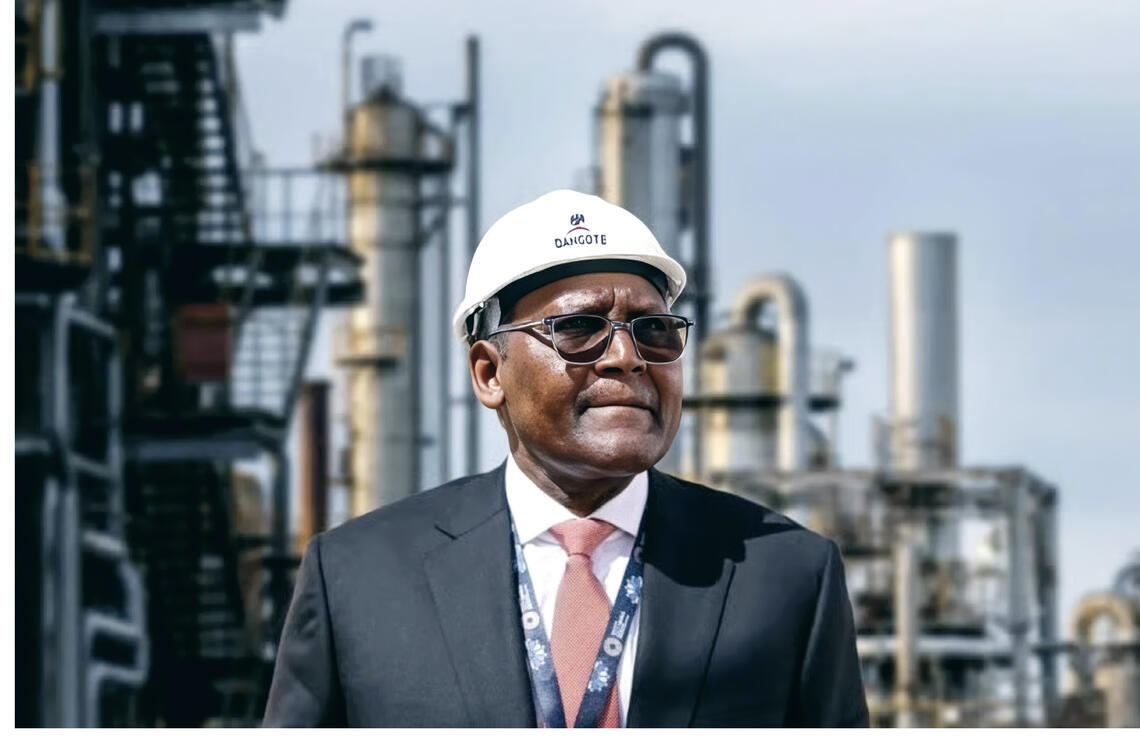
Aliko Dangote
Nigeria
Industry
Africa’s richest man is thinking big: refineries, fuel, fertiliser… Mega-investments that are reshaping the market.
Named by Forbes as the continent’s richest man for the fifteenth consecutive year, with an estimated fortune of more than $28 billion, 68-year-old Aliko Dangote started out with just three trucks. The founder of the eponymous conglomerate quickly realised that, to succeed, he needed to sell Nigerians products essential to everyday life: cement for building, fertiliser for farming, pasta for food… A 1999 trip to Brazil—a country covered in factories—made him realise the dead end Nigeria had reached, forced to import virtually everything, including its fuel—a humiliating paradox for Africa’s leading crude-oil producer. Since then, he has devoted himself to industrialising Africa’s most populous nation and strengthening its economic sovereignty. In the early 2010s, the Dangote Group embarked on a colossal project: building the largest refinery on the continent, with the aim of making Nigeria self-sufficient in fuel.
“I was repeatedly told it would never work.”
Years of construction followed, at a cost of $20 billion—twice the original estimate. Aliko Dangote had to overcome financial and technical obstacles—120,000 concrete piles were driven into the ground to stabilise the swampy terrain—as well as political ones, as fuel importers repeatedly sought to undermine the project. The Lekki refinery began production in 2024. It processes 650,000 barrels of crude oil a day, allowing the Nigerian government to save $3 billion on imports—and even export fuel to neighbouring countries. Dangote, sometimes dubbed the “economic president of Nigeria”, now wants to build an identical refinery on Kenya’s island of Lamu, serving the whole of East Africa . The businessman urges African entrepreneurs to “lead the charge in the continent’s economic transformation” — a continent that holds 30% of the world’s mineral resources, 65% of its arable land and 10% of its freshwater.
“Africa has a myriad of opportunities to build robust, inclusive growth, not only for itself, but for the world.”