
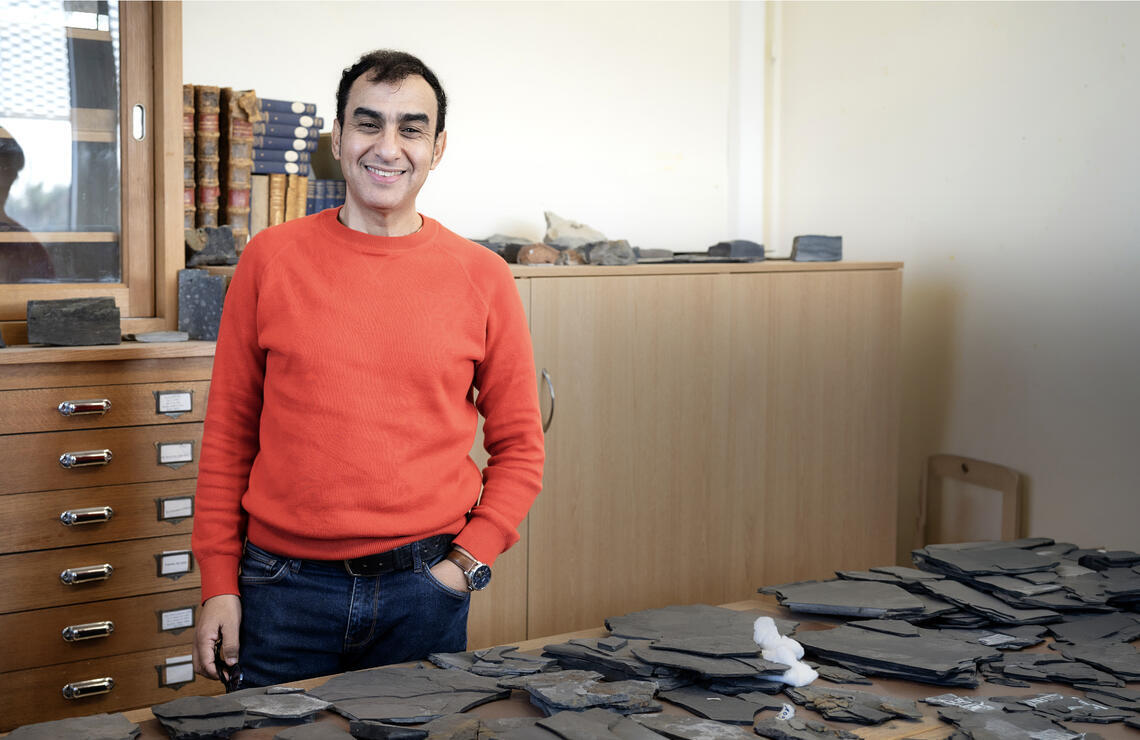
Abderrazak El Albani:
“Are we all the product
of extraterrestrial dust?”
Thanks to his discovery in Gabon of the oldest known multicellular fossils, more than 2 billion years old, Moroccan geologist Abderrazak El Albani has transformed our understanding of the origins of life. In his latest book, he looks back at the major scientific advances of recent years and takes us to the farthest reaches of the living world.
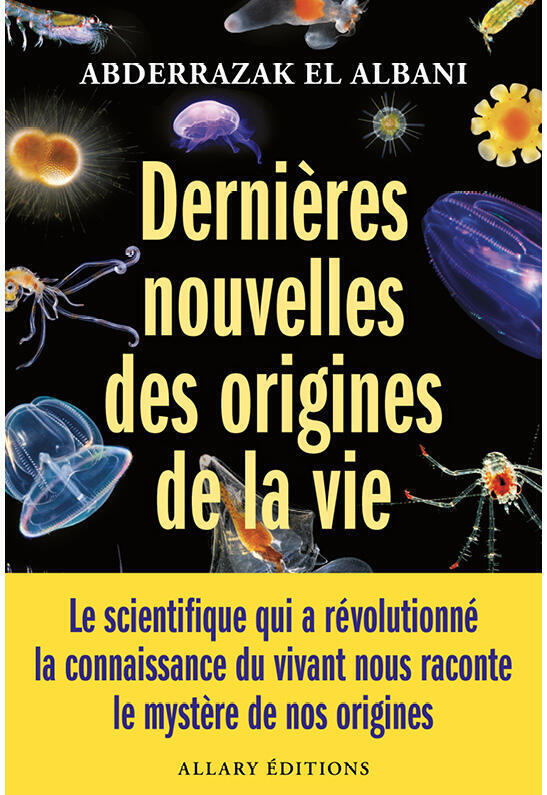
In 2008, Moroccan geologist Abderrazak El Albani discovered in Gabon the oldest known multicellular fossils, dating back more than 2 billion years, at a time when scientists believed such life forms had emerged around 600 million years ago. Since this scientific revolution, which made the cover of Nature, advances in geology, palaeontology, geochemistry and 3D imaging have led to a wealth of new discoveries and influenced numerous areas of scientific research, including work on Mars. A professor of geology, sedimentology and biogeochemistry at the University of Poitiers, El Albani heads an international scientific consortium bringing together 16 institutions and leads a research programme dedicated to primitive environments and early life. Passionate and deeply engaging, he takes stock in Dernières nouvelles des origines de la vie of our current knowledge on a wide range of subjects: the key role of the environment and oxygen, the emergence of the first cells, the rise of biological complexity… A precise, accessible and fascinating book. A journey to the origins of life. And of humanity.
AM: How did you become a geologist?
Abderrazak El Albani: It happened somewhat by chance and by default. At first, I wanted to be a footballer and play for FC Nantes [Football Club de Nantes, editor’s note]. It was my childhood dream, and I was quite good. But one day, my father, a former soldier and prisoner of war, told me, “Now, that’s enough of this nonsense.” I initially enrolled at medical school in Lille, not far from one of my sisters, who lived in Dunkirk. I was accepted, but I had to change direction because we simply could not afford such an education. I then looked for something that would allow me, as someone who had spent his childhood kicking a ball around the streets of Marrakech, to remain connected with life and the outdoors. I have always loved freedom: running, roaming around… The idea of investigating, discovering what nature has to offer, and working on fascinating things such as minerals, plants and the environment appealed to me. So I chose to study geology.
What does the job involve?
A geologist is an investigator who follows the traces of Earth’s history, whether recent or ancient. By observing, sampling and analysing the Earth’s crust, geologists contribute to the scientific exploration of the planet. Studying rocks and their mineral and fossil content provides insight into paleo-environments through biological and geological clues, and allows us to reconstruct ancient landscapes. This is fundamental to understanding Earth’s history through the evolution of ecosystems, the production and storage of resources and, of course, a major issue today: climate change. Our planet is dynamic: continents move and deform, while the climate, the composition of the atmosphere and ecosystems evolve. In a sense, our goal is to make a mineral or organic “object” speak. And that begins with fieldwork. First, we take a broad-scale approach, then move towards smaller-scale analysis using cutting-edge techniques. From the rock all the way down to the molecule.
Are there any explorers, naturalists or scientists who have particularly influenced you?
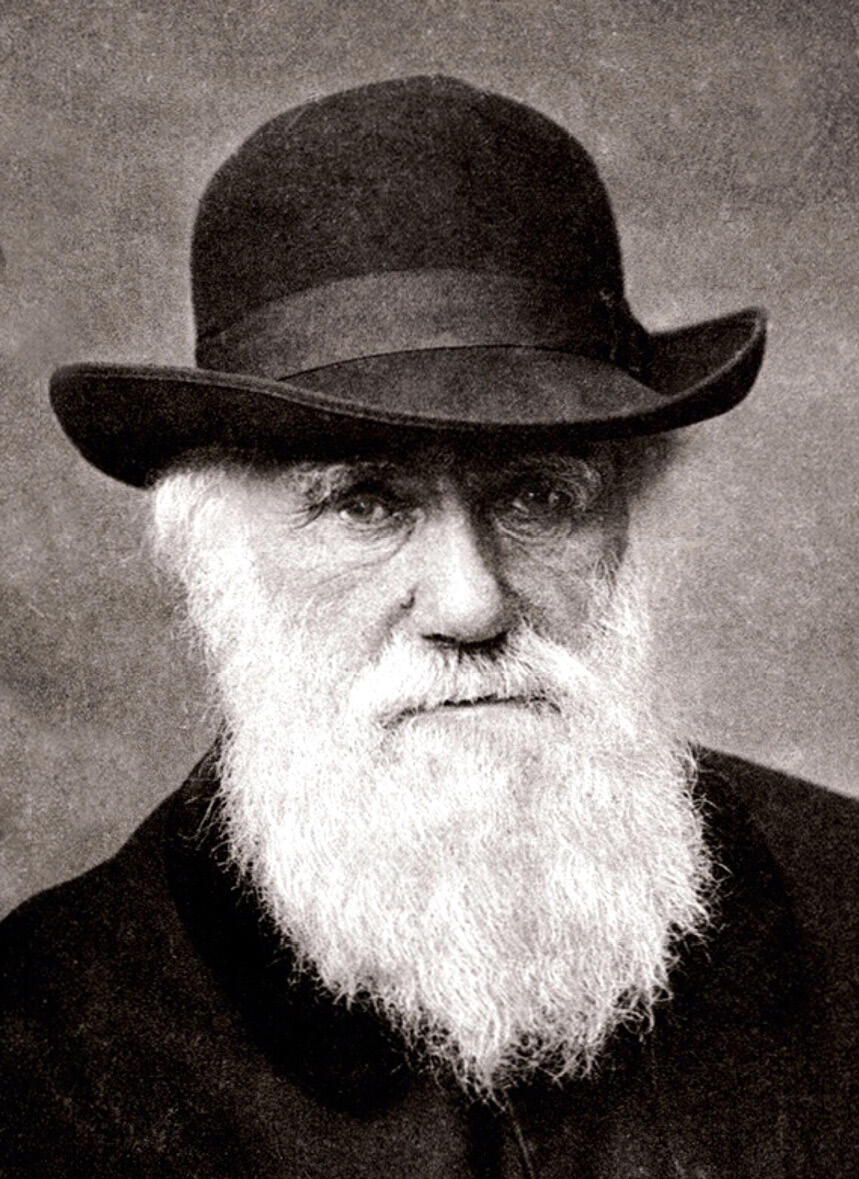
The first, of course, is the British naturalist and palaeontologist Charles Darwin (1809–1882), who revolutionised biology through his voyages aboard the Beagle and his research into the evolution of living species. His theory of evolution, set out in his landmark work On the Origin of Species, published in 1859, suggests that all living species are constantly changing and undergo morphological and genetic transformations over time and across generations. According to his theory, evolution can lead, over shorter or longer periods, to the emergence of new species and the disappearance of others through various processes, including natural selection. However, other scientists had already laid the groundwork in this field, such as the French naturalist Jean-Baptiste de Lamarck (1744–1829), whose work was the first to propose a theory explaining the emergence of living beings through natural evolution. Darwin drew on this work in developing his own theory, although he proposed different mechanisms. What fascinates me about these two men is how innovative and modern their vision was for their time, particularly in a world that was completely closed off and dominated by dogma and religious beliefs. Since then, the theory of evolution has continued to grow, evolve and become more nuanced and complex thanks to scientific advances across different fields. I would also like to mention my friend, Swedish palaeontologist Stefan Bengtson (1947–2024), who, together with his team, discovered in 2017 in the Vindhya Mountains of India the oldest known multicellular eukaryotic fossil — a cell containing a nucleus that houses genetic material — apparently a red alga dating back 1.6 billion years. That is 400 million years older than the fossilised red algae discovered before it. This finding suggests that advanced multicellular life existed on Earth much earlier than previously thought.
Your own major discovery in Gabon in 2008, hailed by Nature in 2010, radically changed our understanding of life and its history…
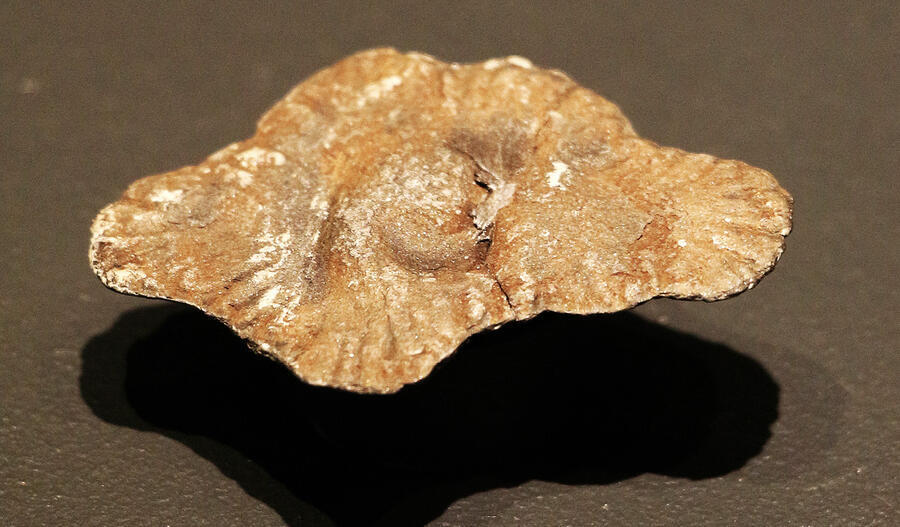
What my team and I discovered at Franceville was completely unexpected. You have to understand that when studying a fossil, you also have to examine the rock in which it is embedded [its surrounding matrix, editor’s note]. It is much like the pharaohs discovered in Egypt: they were found in sarcophagi, which themselves had been buried for millennia in a funerary chamber. Fossils are the same, whatever their age: they are enclosed in gangue. My specialty is making them speak. So, during that famous geological survey mission in Gabon, among all the rocks we examined — sandstone, black shale — a few caught my attention. On top of some pieces of clay, I could see strange, shiny, lobed, radial shapes that bore no resemblance whatsoever to anything I knew from the field of sedimentary geology. At that point, we had two choices. The first was to leave them where they were and remain within the prevailing scientific framework established by Darwin and all those who came after him — namely, that the origins of multicellular life dated back around 600 million years. Even though I had a kind of intuition, I could not see why or how a “provincial” geologist from the Far West — by which I mean Poitiers — could make an important discovery and potentially rewrite the history of multicellularity. The other option was to bring a few samples back to Poitiers and continue investigating. That is ultimately what we did. Well, the Far West had a good instinct. These fossils of multicellular organisms were more than 2 billion years old! I then needed a great deal of patience and resilience, qualities inherited from my upbringing and cultivated when I was young in the streets of Marrakech, to confront the scientific dogmas surrounding the origins of life and those who defended them. Publishing the paper in Nature was not without intense debate.
What makes the Franceville site unique?
The main reason for its uniqueness is that it was never swallowed up by the depths of the Earth. Dating from the Palaeoproterozoic era, which extends from 2.5 billion to 1.6 billion years ago, this site in the Ogooué Basin, in southeastern Gabon, is composed exclusively of sedimentary rocks and has not undergone any metamorphic processes, unlike what is generally observed around the world in rocks from this period. Over geological time, layers of rock become buried under the effects of pressure, contraction and temperature. They can descend as far as 7 kilometres underground. But in the case of the Francevillian formations, which are exceptionally well preserved, they were buried no more than 2.5 kilometres deep. That is unique in the world. And that is where I found those famous black shales, with their strange shapes, which we named Gabonionta and which have advanced our understanding of the origins and evolution of life.
What does your discovery tell us about living organisms?
It shows us that life is highly dependent on its environment. It can emerge and exist only when the environmental conditions are right. There are periods of development, expansion and biological crisis, including mass extinctions. The discoveries in Gabon suggest that the early evolution of life was not gradual but episodic. Biologists and geneticists have also suggested that our work is helping them better understand how genetic mutations operate and what might promote them. More broadly, these questions are of interest not only to scientists but also to philosophers.
In your book, you quote a maxim by Rabelais: “Science without conscience is but the ruin of the soul.”
And I would add that the search for the origins of life has become interdisciplinary, encompassing philosophy, metaphysics and theology. It is a fascinating subject that attracts and engages the general public because everyone wants to understand where we come from. At the same time, many people say all kinds of things without providing facts or evidence. There are even creationist scientists… Our role is therefore to share information through the work we do, particularly as part of the “Sous les pieds de Darwin” project, which I coordinate. The idea is to enable middle- and high-school students in France’s Nouvelle-Aquitaine region to watch the scientific work we conduct in Morocco, Italy and Gabon live as it happens. Each expedition includes live educational sessions, using satellite videoconferencing, with students in their classrooms. The topics range from the origins of life and volcanoes to dinosaurs, water and coastlines. It is a unique opportunity for them to follow our fieldwork and speak directly with us, the scientists, about our profession, our daily lives and our career paths. Hundreds of young people take part. In practical terms, this helps increase enrolment at the University of Poitiers, but above all, it helps limit the harmful effects of TikTok and social media more generally. According to a recent survey by Ifop, a French polling institute, of 11- to 24-year-olds, one in six young French people believes the Earth is flat, while one in four has doubts about the theory of evolution…
“There would appear to be concrete evidence of the presence in the universe of an organic molecule that could play the role of an initiator of life, setting its construction in motion,” you write. Does this tell us that life could exist elsewhere?
A new window has opened thanks to enormous resources and the involvement of dozens of researchers around the world in analysing data from the most powerful telescope ever built, the James Webb Space Telescope, which can observe the most distant galaxies in infrared. In 2023, a potentially crucial molecule was detected in the universe, in the disk of matter surrounding a young star in the Orion Nebula, where future planets are forming. This organic molecule could indeed play the role of an initiator of life. It is a dizzying finding, bringing to mind the image of the “primordial soup” Darwin imagined in a pond: an environment with a chemistry favourable to the emergence of life. However, no one has yet managed to recreate this primordial soup. There are countless hypotheses. What we do know is that we are all the product, the result, of extraterrestrial dust. In other words, the earliest building blocks of life may have come from space. So far, however, laboratory experiments have never managed to take us any further. What we do know, on the other hand, is that very early on, our planet, located at a precise distance from the Sun, brought together the conditions necessary for life. Despite its chaotic history, life has continually adapted to it. That is what makes it unique. Could life have followed a similar path on Mars before disappearing? If samples collected from Jezero Crater on Mars are ever brought back to Earth, perhaps we will have the answer…
In Tristes Tropiques, Claude Lévi-Strauss expressed his hatred of travel and explorers. He criticised a particular way of travelling that reinforces prejudice. How does this resonate with your own fieldwork?
When I travel, what matters is the pursuit of knowledge: learning, discovering, trying to understand. Scientifically and, above all, humanly. I have always enjoyed and been interested in other cultures of work — in Germany, England, the United States, across the African continent, everywhere. Our profession as geologists does not involve putting on an Indiana Jones costume, although it is certainly an adventurous profession. Because if you want to make discoveries, you have to go there. You have to explore. Fieldwork is also a kind of therapy for scientists. All the pressure we face in laboratories — administrative burdens, increasingly tight budget constraints — disappears when we are in direct contact with nature. It also leads to encounters, exchanges and the sharing of expertise. Together, we try to solve a mystery, to delve into the history of planet Earth.
How do things work with local populations, scientists and researchers?
In all the research we have conducted or are conducting — in Gabon, Morocco, Ukraine, Mauritania, Cameroon, Nigeria and elsewhere — I have always signed research agreements, through the French embassies, with local authorities, French institutes, my university and the CNRS, France’s national scientific research centre — my research unit being a joint research unit, an administrative structure bringing together researchers through a partnership between the CNRS and a laboratory or research organisation. On the ground, we always involve local people: villagers, professionals from different fields, research institutions and academics whom we train. Alongside my research, I also build bridges with different countries. In Morocco, for example, we have established university cooperation.
You often mention Africa. How important is the continent to the world of research?
Africa is essential. It offers enormous possibilities for exploration and discovery across the research landscape. And not only in geology. There are countless subjects to investigate and study across the continent. I have a botanical example in mind: argan trees grow naturally only in Morocco and parts of Algeria, in arid and semi-arid regions. They are a kind of surviving specimen from the Tertiary period, thought to have been pushed south-westward during the glacial period. It is a fascinating phenomenon and a remarkable biological singularity. Gabon has become a global reference point for the origins of multicellular life. Africa also offers an extraordinary diversity of research environments for studying diseases, germs, microbiology and, of course, the origins of humanity…
Two months ago, an international team of palaeontologists officially announced the discovery in Morocco of a new dinosaur species, Phosphatotitan khouribgaensis, whose characteristics resemble those of a titanosaur species previously thought to have existed only in South America. This could change our understanding of the evolution and distribution of dinosaurs on Earth. The problem in Africa is the preservation of its heritage. That does not mean closing ourselves off or barricading the continent, but people who come to work there must involve local communities and respect the rules. Unfortunately, the exploitation of fossils, which has become increasingly profitable, has encouraged the emergence of an informal parallel market that violates legislation.
In Morocco, east of Agadir, there is a marine Pompeii — aquatic fauna petrified in volcanic ash in the middle of the Cambrian period. What exactly is it?
They are called trilobites. They are fossilised marine arthropods with numerous small legs that, from a distance, resemble shrimp. This is aquatic fauna petrified in volcanic ash during the Cambrian period, which I was fortunate enough to discover in a valley in the eastern High Atlas, where the rock, transformed into extremely hard silica, bears no resemblance whatsoever to the kind of rock in which one normally looks for fossils. No one had ever found them in volcanic ash. We examined them in three dimensions and carried out a whole series of analyses with international teams — Australians, Americans, Britons and, of course, Moroccans. They were simply the best-preserved trilobites in the world. They illustrated what we call a window into knowledge: a phenomenon limited in space and time, occurring in a particular place that experienced an event at precisely the right moment for preservation. That is what makes it exceptional. As the ash fell into the water, its temperature dropped from 500°C to between 100°C and 200°C, enveloping the trilobites in a kind of instant mould. The impressions of these marine arthropods, including their lips — a first! — remained unchanged for 515 million years.
The poet and sociologist Roger Caillois opened his collection of poetry, Pierres — the stones he collected with the greatest curiosity — with the words: “I speak of stones older than life, which remain after it on cooled planets, when it was fortunate enough to emerge there.” What is your own personal and poetic relationship with stones?
I never stop looking at them and observing them through the eyes of a geological investigator. Wherever I am — in nature, on streets, in churches, castles or ruins — wherever I set foot, I see every detail of the stone, the rock. Fossils, bacteria, periods of geological time — from the Jurassic to the Cretaceous. Sedimentary rocks rich in organic matter are the ones that fascinate me most: clay, limestone, sand… But I have very few stones at home. There is one, however, that I picked up while I was working on my doctoral thesis, and it has sentimental value. As I travelled across the Moroccan Sahara, from Cape Juby to Tarfaya and then towards Dakhla, where the geology is sublime, I came across a block of limestone containing fossils of ammonites, coral, sea urchins… I remember what I said when I picked it up: “This is amazing. This stone is living together.” And ever since, that stone has never left me.